Agentic Robotics: What It Takes to Build a Tattoo Robot
At Austin Robotics on October 28, Hugo Ponte presented Agentic Robotics and brought tatbot for a live hardware demo. Explore the talk, research ideas and public slides.
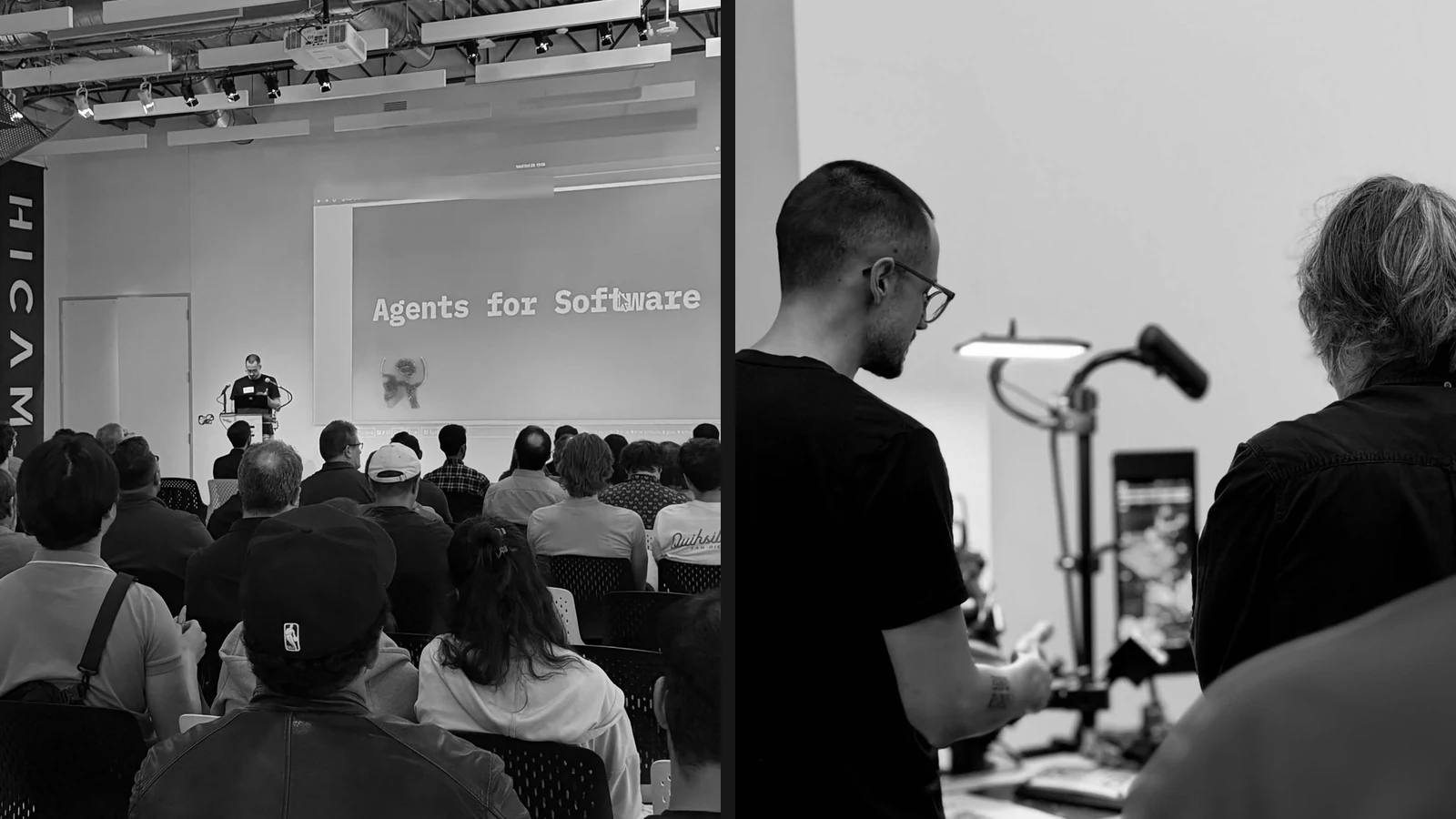
On October 28, I brought tatbot, the open-source tattoo robot, to Austin Robotics at HICAM. My talk, Agentic Robotics: The Evolving Landscape of Agents and Policies, explored how software agents, 3D tools and robot policies fit into the work of building physical machines.
Browse the 36-slide public edition or download the slides as a PDF.
Software agents and robot policies
An agent needs more than a language model. Tools, context and a loop for acting on results give it a way to work on a task. In software, that might mean editing code, running it and reading the output.
Robotic control introduces a different job: turning observations into actions on hardware. The talk follows that distinction through visuomotor policies, vision-language-action models and systems that pair a planner with a robot policy. The System 1 and System 2 analogy helps describe these roles, although the cited projects implement them differently.
3D tools and a tattoo robot's workspace
The slides also explore agents for 3D work, including MeshFormer and Blender tools, alongside Tatbot's palette and hardware. A tattoo robot brings software decisions into a physical workspace: cameras observe surfaces, calibration relates those observations to the arm, and a tool must follow the intended path.
I brought the arm for a live hardware demonstration so the discussion had a physical reference point. The photographs above show the talk and the conversations around the robot afterward.
The robotics research loop
The last part of the presentation looks beyond a single action: propose an experiment, run it, inspect the results and choose the next change. I call this outer research loop System 3 in the talk.
Research examples include ASPIRE and ENPIRE. Their results belong to their authors' tasks and evaluation conditions. The Tatbot architecture at the end of the deck is a research direction; the talk does not establish autonomous tattooing capability.
Explore the talk
The public slides include links to the original research and demonstrations. Video previews open their original sources. Thank you to Austin Robotics and HICAM for hosting; see Tatbot's event photographs and explore the open-source tattoo robot project.