The physics of tattooing: how needles deliver ink into skin
Tattooing brings together puncture mechanics, fluid flow and pigment particles. Understanding how they interact explains why a needle's movement, the ink it delivers and the mark that remains need separate measurements.
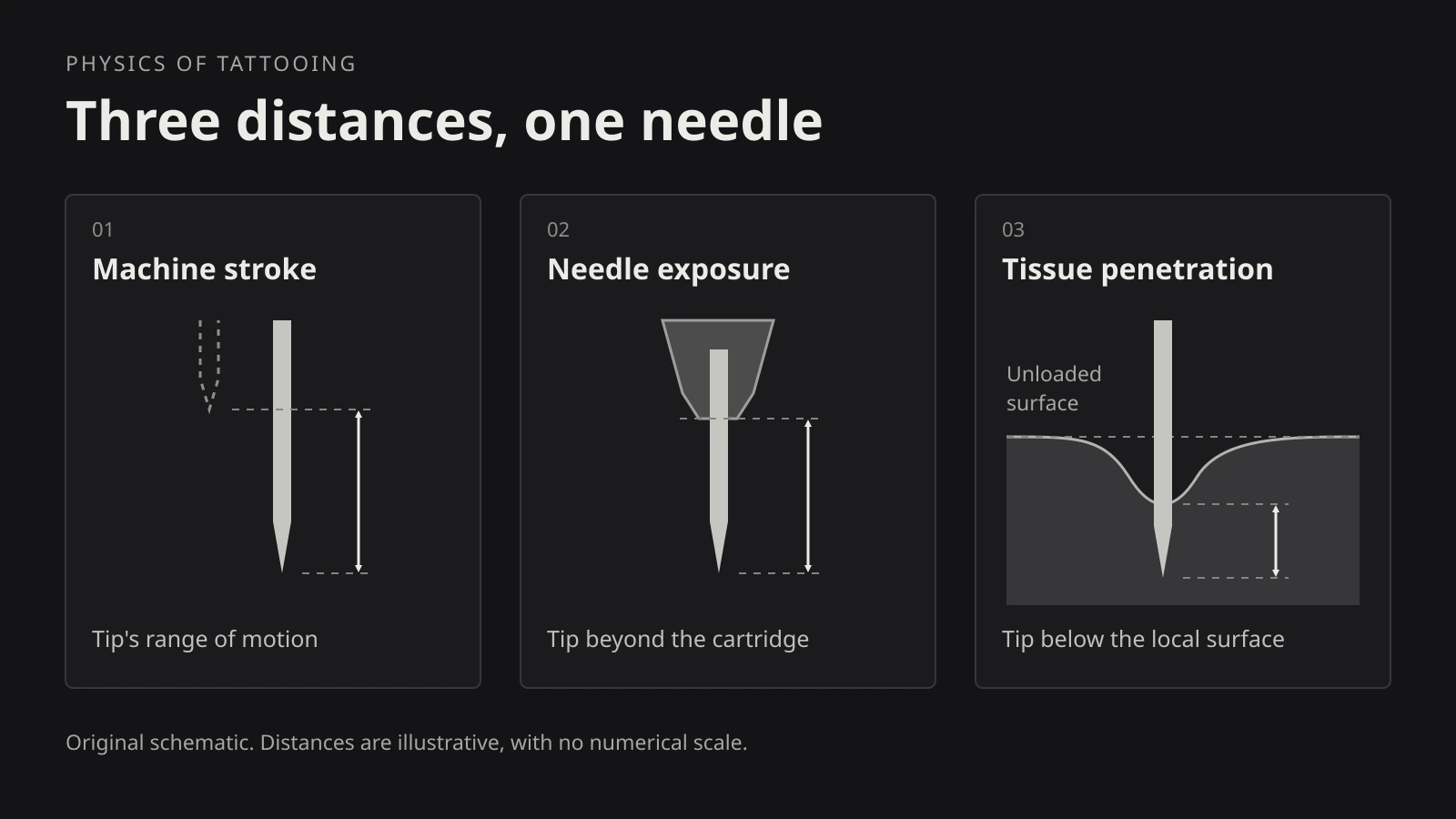
A tattoo needle repeatedly opens a route through a surface while transporting liquid and pigment. The material moves around the needle, the liquid changes shape, and some of the pigment becomes part of a lasting mark. A description of the tool's route captures one part of this process. Explaining the mark requires mechanics, fluid dynamics and, over longer times, biology.
For tattoo robotics, that distinction defines a research problem: how can a machine connect the motion it commands to the pigment distribution it produces? The useful starting point is the physical interaction at the needle, before choosing an algorithm to control it.
What a tattoo needle carries
Conventional tattooing uses solid needles with liquid around their surfaces. Studies comparing this process with needle-free liquid jets make the delivery route explicit: a solid tool carries a wetting film into an opening, while a jet transfers momentum through the liquid itself. These are different physical arrangements for bringing fluid into a material. Oyarte Gálvez, Brío Pérez and Fernández Rivas, 2019.
The ink contains particles as well as a liquid carrier. In a study of 58 commercial inks spanning six colors, Høgsberg and colleagues used laser diffraction, electron microscopy and X-ray diffraction to characterize particle sizes. Their results showed substantial differences among inks and identified nanoscale particles. An ink's color name alone therefore gives an incomplete description of its material composition. Tattoo inks in general usage contain nanoparticles, 2011.
Measurements also depend on how a particle is observed. Grant and colleagues combined particle-size measurements with microscopy of a commercial black ink, tattooed skin and cultured fibroblasts. They observed individual particles alongside aggregates. A cluster's dimensions and the dimensions of its constituent particles describe different structures. Tattoo ink nanoparticles in skin tissue and fibroblasts, 2015.
This makes several quantities worth keeping separate: liquid delivered into a sample, mass of pigment delivered, particle distribution and visible darkness. For an idealized suspension of uniform concentration, multiplying delivered liquid volume by pigment concentration would estimate pigment mass. Applying that accounting requires checking the concentration of the material actually transferred. A photograph of a dark region supplies a different measurement.
Skin moves before a needle enters
A needle approaching a compliant surface first loads and deforms it. As the tip advances, some motion changes the surface's shape. Puncture introduces a new mechanical event: the material opens around the tip. In microneedle experiments on living human skin, Davis and colleagues measured insertion forces and examined how tip geometry affected them. Their devices were microneedles for delivery research, so their measured forces belong to those geometries and conditions. Insertion of microneedles into skin, 2004.
Skin's response also depends on direction and location. Ní Annaidh and colleagues tested 56 excised human back-skin samples in tension, measuring deformation and examining collagen orientation. Their results connected mechanical behavior to sample orientation and location. These were tensile tests, which characterize a different loading mode from a rapidly reciprocating tattoo needle. They help explain why a single stiffness value describes only a particular test. Characterization of the anisotropic mechanical properties of excised human skin, 2012.
How the sample is held matters too. In ex vivo hypodermic-needle experiments, Butz and colleagues found that applying prestress reduced skin deflection and variation in penetration depth, while increasing the force required to reach a target depth. This links tension, displacement and loading in a particular injection setup. It provides a reason to measure the support and tension of a tattooing specimen when investigating contact mechanics. Prestress and needle penetration, 2012.
The opening illustration separates three geometric quantities. Machine stroke is the distance between the needle's most retracted and most advanced positions relative to its mechanism. Needle exposure is how far the tip projects beyond the cartridge at a specified point in that cycle. Penetration describes the needle's entry relative to the material around it. Each needs a reference position; penetration also needs an account of the moving surface.
Consider a purely geometric example. A tip moves below the surface's original position while the surface deflects downward with it. The distance from that original position includes both deflection and entry. Measuring the current surface alongside the tip lets an observer distinguish the two. Motion measured inside the machine and motion measured relative to the material answer different questions.
The diagram is an original schematic of these definitions. It has no depth scale and represents no particular cartridge, body site or measured tattooing run.
How liquid enters a puncture
Lawal, Rohilla and Marston filmed a five-needle array entering gelatin at 8,000 frames per second. Their 2022 study observed the surface depressing, relaxing and rising during withdrawal, followed by liquid entering cavities. They proposed capillary imbibition, or wicking, as part of the delivery mechanism. Their paper explicitly describes a qualitative explanation requiring further quantitative work. Visualization of drug delivery via tattooing, sections 2 and 3.1.
These observations give withdrawal and surrounding liquid a role in the process. A model has to account for cavity shape, nearby liquid, and interactions among liquid, needle and substrate. Delivery in living skin requires corresponding measurements there.
Laboratory models make otherwise hidden events measurable. Establishing which relationships transfer requires changing the material, needle arrangement and motion.
Ink changes as it flows
Viscosity describes resistance to flow under specified conditions. For a shear-thinning liquid, apparent viscosity decreases as shear rate increases. A 2026 study of a photochromic tattoo ink measured this behavior with rotational rheometry. The result characterizes that formulation across the tested rates; it also illustrates why a useful viscosity measurement includes the measurement conditions. Physical characterization of photochromic tattoo ink, rheological properties.
Getting liquid to adhere to a needle, enter an opening and remain spatially localized involves several interactions. In moving-needle experiments through agarose, Oyarte Gálvez and colleagues observed more defined tracks with their permanent-makeup inks and broader spreading with aqueous test liquids. The formulations also differed in adhesion and viscosity, so those comparisons involve coupled properties. Moving injection experiments, section III.C.
A formulation can therefore change both how material reaches a puncture and how it spreads afterward. The research question needs an outcome: transferred volume, pigment mass, spread width or another quantity. Maximizing one of these would define a different objective from maintaining a narrow, consistent line.
For an experiment, recording the ink identity, preparation, temperature and measurement method makes comparisons more interpretable. A measured flow curve provides more information than a description such as thick or thin. Whether that curve predicts transfer in a particular needle system remains something to test.
A line combines two motions
Tattooing along a line combines needle reciprocation with travel across the surface. Frequency counts cycles per second. Travel speed counts distance per second. Dividing frequency by travel speed gives cycles per unit distance for an ideal point moving at constant speed.
For an original arithmetic example, take an ideal point cycling 60 times per second while traveling at 6 millimeters per second. It completes 10 cycles per millimeter, with successive cycle positions separated by 0.1 millimeter. At twice that travel speed and the same frequency, it completes five cycles per millimeter, separated by 0.2 millimeter. These are calculated positions, with no assumed ink volume or tissue response.
The ratio describes exposure along a route. A real cartridge has multiple tips, a finite footprint and a portion of each cycle during which contact may occur. Neighboring tip paths can overlap. Changes in travel speed, repeated passes and time spent at a corner change the history of loading at a location. A model of the resulting mark needs those spatial and temporal relationships.
An ideal sinusoidal needle motion adds another distinction. If the full, peak-to-peak stroke is S and frequency is f, maximum needle speed is pi times S times f. This follows by differentiating a sine wave whose amplitude is half the full stroke. It describes speed along the needle's oscillation, while travel speed describes movement of the head across the surface. Real mechanisms and loading require their own measured motion profiles.
Experimental comparisons need the same care. Lawal and colleagues found no significant frequency effect on delivered volume in gelatin at fixed puncture counts. Their excised-human-skin tests instead used fixed-duration applications and measured stained cross-sectional area, which increased with frequency. Counts, duration, material and endpoint all changed between the comparisons. Gel and excised-skin results, sections 3.2 and 3.3.
For a tattoo robot, this suggests recording measured travel speed alongside needle frequency and engagement history. Those records would let an investigator ask whether variations in a line coincide with changes in exposure. Establishing the cause would still require controlled comparisons and measurements of the mark.
The needle is part of the material system
The working tip has a physical shape and surface. Jin, Oh and Chang examined five-round-shader needles with scanning electron microscopy and elemental analysis. Their observations included both rounded and deformed tips. The examined specimens demonstrate that nominal needle grouping and microscopic tip condition describe different aspects of a tool. Material analysis on semi-permanent makeup needles, 2024.
Contact can change the tool during use. Schreiver and colleagues investigated metal particles in human tattooed skin and lymph nodes, then performed tattooing experiments on pig skin. Their comparisons found greater needle wear with titanium-dioxide-containing white ink than with carbon black ink. Microscopy of the needles and analysis of material in the skin connected wear to the interacting ink and tool. Distribution of particles from tattoo needle wear, 2019.
For the physics, this means a tool's initial geometry is one part of its description. A comparison of marks can also record the cartridge specimen, ink, accumulated work and observed tool condition. Otherwise an investigator may attribute a change entirely to motion while leaving a changing contact surface unexamined.
The mark continues to change
The initial deposit enters a biological environment. In mouse experiments, Baranska and colleagues showed that pigment could pass through cycles of capture, release and recapture by macrophages, a type of immune cell. The visible tattoo persisted through renewal of the cells carrying pigment. That is evidence for a persistence mechanism in their mouse model. Skin macrophage dynamics and tattoo persistence, 2018.
A later mouse study found pigment in both macrophages and fibroblasts, with different distributions between the populations. It adds detail to the cellular picture and helps keep a simple illustration of a pigment-filled cell from becoming a complete explanation of every tattoo. Macrophages and fibroblasts contribute differently to tattoo stability.
Investigators can also study a controlled biological model over time. A 2025 study tattooed reconstructed human skin models containing an epidermal layer and a fibroblast-containing dermal compartment. Histology showed pigment along puncture channels; subsequent measurements tracked cellular responses over seven days. The model adds biological measurements to a physical puncture experiment, within the composition and observation period of that model. Tattooed human in vitro skin model, 2025.
Liquid entry, pigment deposition and the later mark therefore belong to different observation times. A useful result specifies when it was measured and what the specimen was. This allows an immediate gel image, a sectioned tissue sample and a delayed biological observation to contribute evidence appropriate to each question.
What tattoo robots need to measure
Tatbot is building tattoo robots for artists and studios. The physical questions above suggest a way to organize experiments: connect a measured tool interaction to a measured result, while recording the material and tool conditions. The project's public code provides engineering context; the measurements needed to establish each relationship belong with the corresponding experiment.
The earlier article From artwork to toolpath follows how a drawing becomes a motion description. Here the next step is to measure what that motion does. Useful observations might include the needle's actual cycle, the surface's displacement, travel speed, deposited pigment distribution and changes over time. Each observation should identify its coordinate reference, time interval and measurement method.
A camera image of the resulting line can measure visible continuity and width under stated imaging conditions. A cross-section can reveal distribution through a sample. A fluid-volume estimate needs a geometric or other measurement model. Comparing those observations would help explain which aspects of a result correlate with the commanded and measured motion.
The most informative experiment can be a small one: hold the material, ink and tool conditions as consistently as possible, vary one defined aspect of motion, and report the resulting distribution alongside the measurement uncertainty. That would turn a question about a darker or wider mark into a test of a specific physical relationship. Repeating such tests across materials would establish where a useful model transfers and where it needs to change.