How to Track Skin
From fingerprints to ultrasound, researchers use different clues to follow a surface that stretches, slides, and changes under touch.
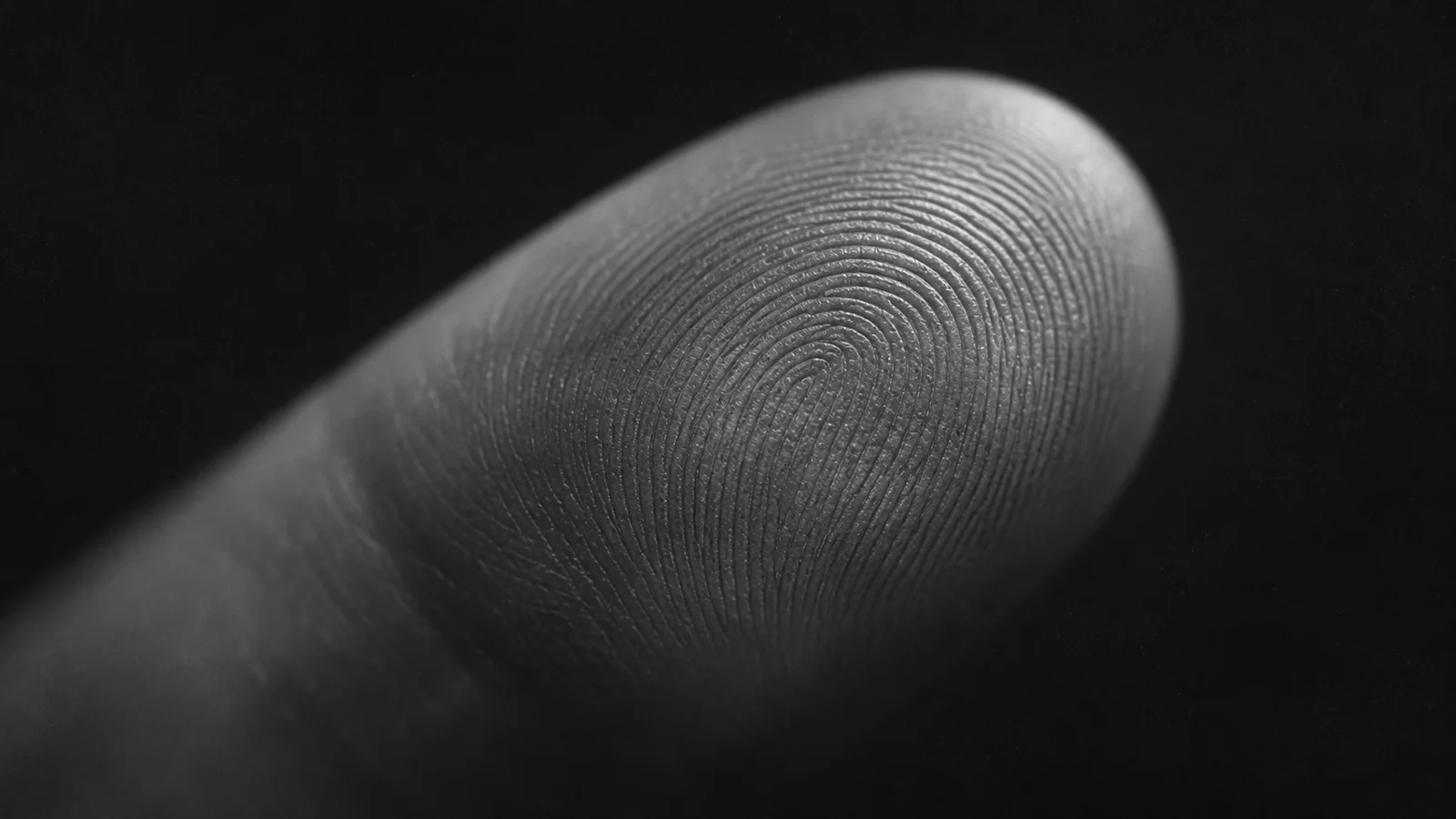
A fingertip pressed against glass can start slipping at the edges while the middle still grips. Researchers watched this happen by filming fingerprint ridges through the glass. As the glass moved, the ridges revealed where the skin was still holding, where it began to slide, and how it stretched in between. A later experiment linked the onset of slip to activity in tactile nerve fibers. A grip can look steady from across the room while different parts of the contact are already moving. Fingertip strain under shear, imaging and nerve recordings during slip.
The same problem comes up at larger scales. Turn a forearm and a freckle can move even when the outline of the arm looks much the same. A depth camera can describe the shape at each instant. To follow that freckle, the camera also needs a way to recognize it from one view to the next.
Give the camera something to follow
A temporary pattern can make movement visible on skin with little contrast. In one shoulder study, researchers printed random speckles on temporary-tattoo paper and photographed them from two angles. Software matched small neighborhoods of dots across the images. With calibrated cameras, it could place those neighborhoods in three dimensions and measure how the distances between them changed. The method is called digital image correlation. The researchers used diffuse lighting to reduce glare from the decal. Barbar Askar and colleagues on shoulder strain.
The patterns reveal changes that a single reference point would miss. A study of 15 participants mapped skin stretch around joints, across the trunk, and on the face. When one participant puffed their cheeks, both the size and direction of the stretch varied across a single patch. In another study, researchers used semi-permanent speckles to film manual pulls on the upper back. Skin close to the hand moved farther than skin farther away. Both studies followed many small regions at once, so they could see how the motion spread. Rupani and colleagues on posture and stretch, Kao and colleagues on skin motion under a manual pull.
Use the texture already there
Pores, ridges, and variations in color can give a camera its own landmarks. In a study of freehand ultrasound, a small camera on the probe looked at skin beside the contact area, where the probe's pressure had less effect. It followed natural texture through gel, with a sticker of known size to give the map a scale. The estimate accumulated about 0.9 mm of position error per 10 mm of probe travel in scans of three immobilized body sites on one person. A later system combined two cameras and an inertial sensor on the probe. Sun, Gilbertson and Anthony on skin-feature tracking, He and colleagues on probe-mounted stereo and inertial sensing.
Facial performance capture offers a different way to limit drift. A team at Disney Research and ETH Zürich reconstructed faces with multiple cameras and picked moments when an actor returned to a similar expression. Matching those moments directly to an earlier reference limited how much error could accumulate across successive frames. Beeler and colleagues on markerless facial capture.
Account for the tool
The right measurement depends on what happens at the point of contact. A tattoo stencil connects a drawing to the skin it will appear on. For a microneedle, the position of the tool tells you where its tip is expected to land. Researchers used optical coherence tomography, a way of making cross-sections with light, to observe how far microneedles actually entered the skin in an experiment. The physics of tattooing, Enfield and colleagues on imaging microneedles in skin.
The pressure of an ultrasound probe can change the shape of tissue even when a sensor locates the probe accurately. In one freehand 3D ultrasound study, researchers used an external sensor to locate the probe and aligned features inside the ultrasound images to reduce distortion from pressure. A 2026 study of optical skin imaging tackled motion in two steps. A physical attachment steadied the skin, then software aligned the images to reduce the remaining motion artifacts. Treece and colleagues on probe-pressure distortion, Guo and colleagues on motion correction in optical skin imaging.
Find the same spot again
Following a spot across a video is one challenge. Finding it again days later is another. In one skin microscopy study, researchers used a temporary surface mark to return to a tiny region and matched microscopic structures to refine the alignment. For photographs of a tattoo fading over a series of laser treatments, the design itself changes between visits. The surrounding skin offers additional landmarks for lining up the images. Repeated imaging of the same skin microstructures, how laser tattoo removal works.
A useful test for any tracker is to choose a point inside the area that matters and see whether the system finds it again after the skin stretches, the tool lifts, or the view is briefly blocked. A marker at the edge can help the camera recover the neighborhood. The harder measurement is where the skin went at the place the tool actually works.